Start with the scope of your home
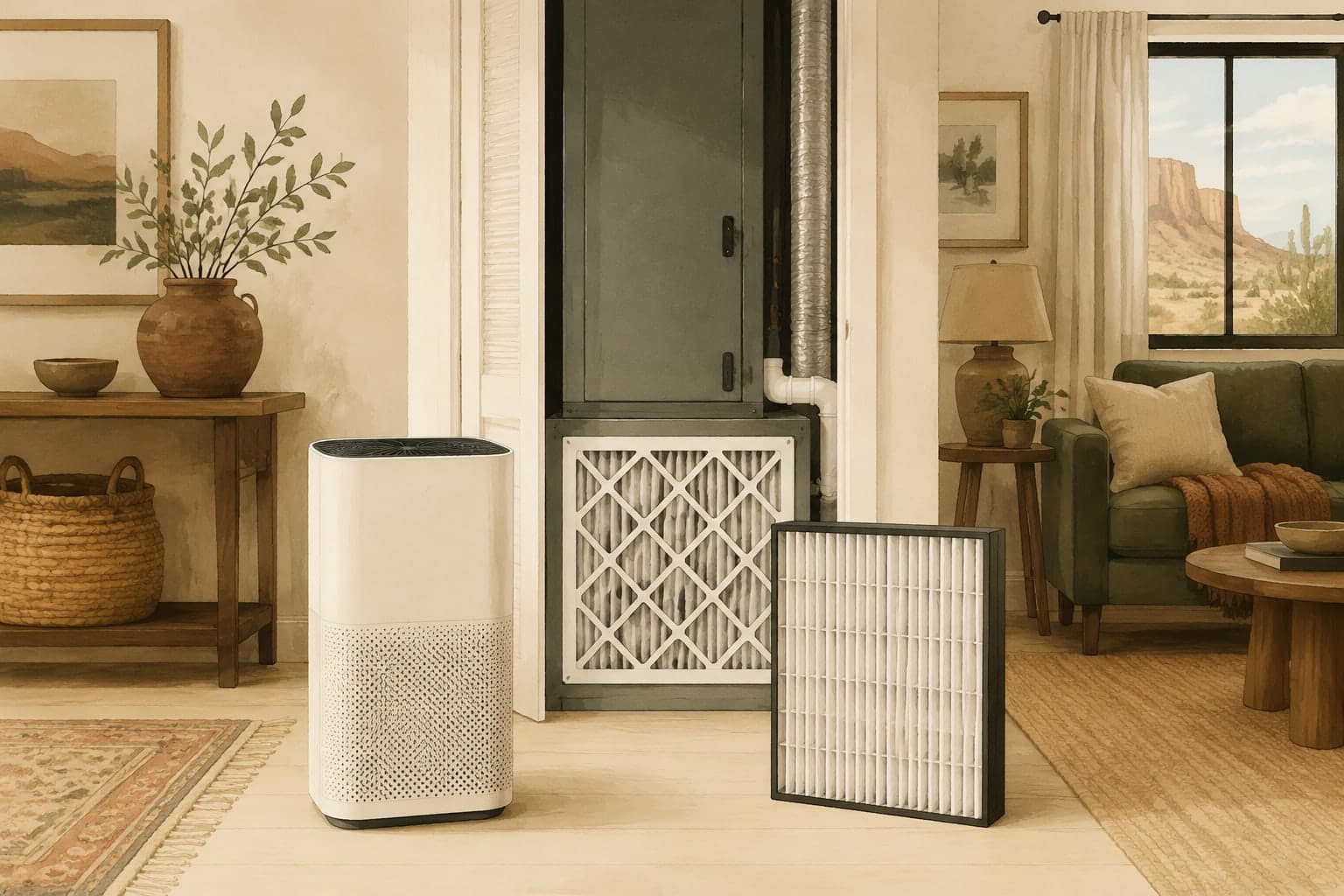
If you live in Phoenix, Tucson, Bakersfield, Fresno, or another area where Valley fever occurs, improving indoor filtration is a practical way to reduce exposure to airborne particles. You can start with a room air purifier or assess the filtration in an existing central heating and cooling system. CDC includes indoor air filtration in its recommendations for reducing Valley fever exposure. CDC prevention guidance
The important limit: filtering spores out of air is not the same as proving that a particular product prevents infections. We did not identify a controlled residential trial establishing how much an HVAC upgrade or room purifier reduces Valley fever illness. The recommendations here combine public-health guidance, exposure studies, and established particle-filtration principles.
CDC prevention guidance · Source checked 2026-09-06
Why this matters in Arizona and California
Valley fever, also called coccidioidomycosis, follows inhalation of spores from the soil-dwelling fungus Coccidioides. Disturbing contaminated soil can release spores into the air. The disease generally does not spread between people. CDC
Arizona reported 14,763 cases in 2024, with 93% in Maricopa, Pima, and Pinal counties. Its statewide reported incidence was 193.7 per 100,000 people. The state cautioned that malfunctioning test kits may have contributed up to 800 false-positive cases to that total. Arizona 2024 annual report
California reported nearly 12,500 cases in 2024. CDPH identifies the southern San Joaquin Valley as its highest-rate region, with increases also occurring in the northern Central Valley and Central Coast. CDPH, August 2025
High burden does not mean cases increase every year. Maricopa County reported 4,833 cases from January through July 2026, compared with 5,598 during the same months in 2025; both years were preliminary in the county's July 31 update. Maricopa County surveillance
These are population surveillance figures, not a prediction of an individual household's exposure. County boundaries also do not identify exactly where contaminated soil is present.
CDC · Source checked 2026-09-06
Find your county guide
Choose a local guide for dated case information, a room-sizing example, and questions for an HVAC assessment.
What the research tells us
Three studies help explain the practical approach:
- Control dust before it enters a building. A 2017 study compared 89 solar-farm workers with clinical illness against 325 asymptomatic workers. Frequent dust-cloud exposure was associated with higher odds of illness; wetting soil before disturbance was associated with lower odds. This observational study supports dust control but does not measure household purifier effectiveness. Sondermeyer Cooksey et al., American Journal of Public Health
- Assess the whole HVAC system. A NIOSH investigation at California prisons supported replacing MERV 8 filters with MERV 13 or 14 to reduce indoor dust exposure. A tested upgrade reduced supplied airflow by about 10%, illustrating why compatibility matters. The investigation did not establish a reduction in infections from the filter change. NIOSH investigation
- Visible dust is an incomplete exposure signal. Researchers sampled air at 11 Phoenix-area locations for more than 18 months. Fungal detection varied across locations and time, and reported dust-storm days did not have significantly higher detection. The measurements detected DNA; they did not determine an individual's infection risk. Porter et al., Scientific Reports, 2024
Sondermeyer Cooksey et al., American Journal of Public Health · Source checked 2026-09-06
Choose the scope that fits your home
| Option | Most useful when | What you are paying for | Limitation |
|---|---|---|---|
| Portable room air purifier | You rent, have a limited budget, or want to prioritize a bedroom | A fan, particle filter, replacement filters, and electricity | Primarily serves the room where it operates |
| Compatible higher-efficiency central filter | Your existing HVAC equipment can accommodate it | Replacement filter and, when needed, compatibility assessment | Cleaning depends on airflow through the filter and system runtime |
| Installed whole-home media filter cabinet | Your current filter arrangement limits a suitable upgrade | Cabinet, connections, labor, and airflow verification | Requires a site-specific design and quote |
| More extensive HVAC and duct improvements | Dust entry, return-air leaks, poor airflow, or aging equipment also need attention | Diagnosis and correction of documented building/system problems | A new air conditioner alone does not establish effective filtration |
EPA distinguishes room air cleaners from central filters and recommends matching either option to the space and equipment. A portable unit can supplement an existing HVAC system. EPA air-cleaner guide
EPA air-cleaner guide · Source checked 2026-09-06
The lower-cost option: filter the room you use most
A bedroom or regularly occupied home office is a practical starting point. Choose a purifier with enough clean-air delivery for that room, keep its intake and outlet unobstructed, and follow the maintenance instructions. Longer operation and higher fan speeds generally increase the amount of air cleaned. EPA
EPA · Source checked 2026-09-06
Compare clean-air delivery, not only the largest coverage number
Clean Air Delivery Rate, or CADR, describes how quickly a device delivers particle-cleaned air. AHAM's room-size guidance uses approximately 4.8 air changes per hour. Its simple buying rule is a smoke CADR of at least two-thirds of the room's floor area for a standard-height room. Higher ceilings require additional capacity. These are general air-cleaner sizing guidelines, not a Valley fever prevention threshold. AHAM sizing guidance, AHAM air-change explanation
For example, a 12-by-15-foot bedroom is 180 square feet. The two-thirds rule gives a starting smoke CADR of 120 cubic feet per minute. Allow extra capacity if you expect to run the device below its highest setting. A quiet-mode noise claim and a maximum-speed CADR do not describe the same operating condition.
AHAM sizing guidance · Source checked 2026-09-06
Three room purifiers to compare
This is a research-based shortlist, not a Temperaly laboratory ranking. None of these products has been demonstrated here to prevent Valley fever. Product specifications below come from the manufacturers; confirm the exact model and replacement filter before ordering.
| Model | Why consider it | Manufacturer specification | Main buying caveat |
|---|---|---|---|
| Levoit Core 300-P | An inexpensive starting option for a smaller room | Listed CADR: 143 CFM; manufacturer room rating: 222 sq. ft. at 4.8 ACH | Current copy describes three-stage particle filtration; do not assume an older review's HEPA claim applies to the current filter. Specifications |
| Coway Airmega 100 | Compact option for a small bedroom or office with a manufacturer-listed HEPA filter | Smoke CADR: 108 CFM; dust CADR: 124 CFM | Its 810-sq.-ft. headline is based on one air change per hour. Using AHAM's two-thirds rule, 108 smoke CADR corresponds to roughly 162 sq. ft. Specifications |
| Levoit Vital 200S-P | More capacity for a larger bedroom or living area | Listed CADR: 250 CFM; manufacturer room rating: 388 sq. ft. at 4.8 ACH | The current page qualifies its HEPA-grade claim to Sleep Mode. Do not combine that claim with maximum-speed performance. Specifications |
At the research check, Levoit's collection page listed the Core 300-P at $89.99 and Vital 200S-P at $169.99. These are dated manufacturer-page price observations, before applicable taxes, not Amazon prices or guaranteed offers. Variants and availability can differ. Check the seller's current price and the cost of compatible replacement filters. Manufacturer collection
For a larger room where you specifically want a manufacturer-listed HEPA filter, the Coway Mighty AP-1512HH is another comparison option: its manufacturer lists 233 CFM smoke CADR and 361 sq. ft. at 4.8 ACH. Coway specifications
Our recommendation is to buy enough particle-cleaning capacity for your actual room before paying for app controls or a larger headline coverage claim. A properly sized, affordable device that you can comfortably keep running is a more useful starting point than an undersized device bought for its filter label alone.
Specifications · Source checked 2026-09-06
The whole-home option: improve central HVAC filtration
A central system can filter air that circulates through its return and supply network. Begin by finding out what filter it has now and what its blower, filter slot, and ductwork can accommodate.
MERV 13 is a useful target when compatible. EPA lists minimum average capture efficiencies of 85% for particles in the 1–3 micrometer range and 90% for the 3–10 micrometer range. Those are standardized filter-performance figures; they are not the percentage of infections prevented or the percentage of all household air cleaned. EPA MERV ratings
For equipment that needs a different filter arrangement, an installed media cabinet is one option. For example, the AprilAire 2410 includes a MERV 13 filter in a whole-home cabinet. This is an example of the equipment category, not evidence of product-specific Valley fever protection. AprilAire 2410
Ask the contractor to include these items in the assessment and proposal:
- Filter fit: exact filter size, efficiency, and a sealed rack or cabinet that limits air bypass.
- Airflow: whether the proposed filter resistance is compatible with the equipment; measurements before and after the change.
- Air pathways: inspection for outdoor dust entry and return-duct leakage where relevant.
- Operating plan: when the fan will circulate air, how occupied rooms are served, and the effect on energy use and comfort.
- Maintenance and cost: installation labor, any duct alterations, recurring filter expense, and replacement instructions.
CDC emphasizes filter fit, maintained equipment, and avoiding air bypass. The NIOSH prison investigation additionally documented unfiltered outdoor air entering through open doors and windows. CDC filtration guidance, NIOSH investigation
A complete installed price needs that scope. A filter swap, a cabinet installation, and a replacement heating/cooling system are different projects. Ask for them as separate options. Replacing working heating and cooling equipment solely because of Valley fever concerns should not be the default recommendation; first establish whether filtration can be improved in the existing system.
Request an indoor-air-quality assessment and describe your current filter, the rooms you want to address, and any nearby dust sources. Ask the provider to explain the purpose and price of each proposed improvement.
EPA MERV ratings · Source checked 2026-09-06
Reduce dust entry alongside filtration
Stay inside and close exterior windows and doors during dusty conditions. Avoid unnecessary exposure to excavation or construction dust. CDC recommends a fitted N95 respirator when dusty exposure cannot be avoided. Indoor filtration cannot protect you during time spent outside. CDC
For buildings with mechanical outdoor-air supply, have a qualified professional assess its filtration and operation. Outdoor air can be a dust source, but permanently disabling required ventilation is not an appropriate general solution.
Neither a filter's efficiency percentage nor a consumer purifier's air-quality display establishes that a room is free of Coccidioides. Use filtration as one exposure-reduction measure, together with dust control and appropriate medical advice.
CDC · Source checked 2026-09-06
When symptoms need medical attention
Persistent cough, fever, fatigue, or breathing symptoms after time in an affected area should prompt a conversation with a healthcare professional about Valley fever. CDPH advises asking about it when compatible symptoms last more than 7–10 days; severe breathing difficulty needs urgent attention. An HVAC visit or air purifier cannot diagnose or treat an infection. CDPH guidance
CDPH guidance · Source checked 2026-09-06
Editorial review: 2026-09-07