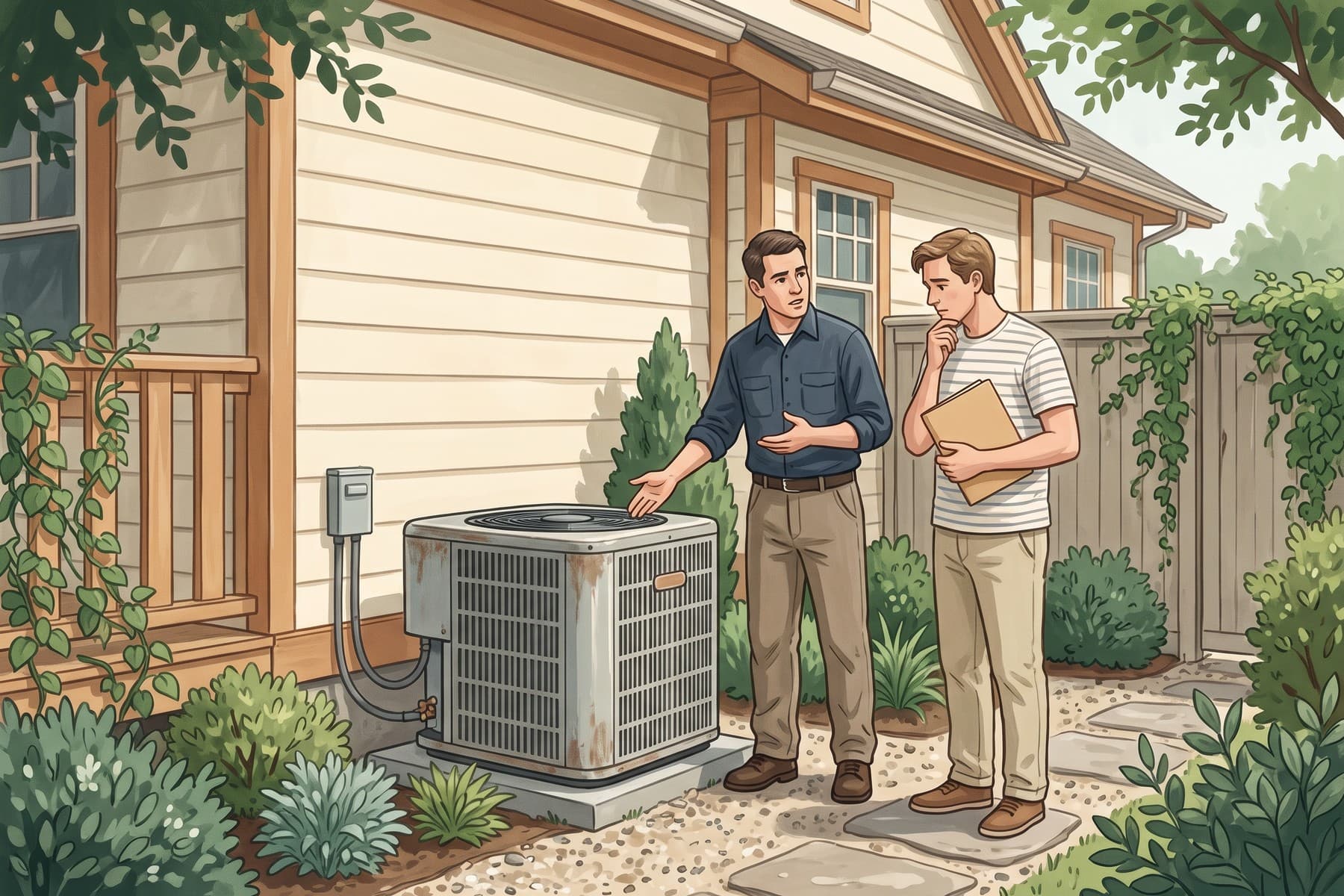
Start with what failed, not the age on the label
A repair-or-replace decision needs a diagnosis, a repair scope, and a realistic replacement alternative. Age alone does not tell you what failed or how much useful service a repair can provide. Frequent repairs, rising energy use, and persistent comfort problems are reasons to have the whole system evaluated.
ENERGY STAR — When to replace heating and cooling equipment · Source checked 2026-09-06
Get four answers before deciding
Ask for the assessment in plain language and keep it with the written estimate.
- What failed, and what observation or measurement supports that diagnosis?
- Does the repair resolve the underlying problem, or only one symptom?
- Which parts, labor, and follow-up visits are included, and what warranty applies?
- What is known—and still uncertain—about the condition of the rest of the system?
If replacement is recommended, ask why repair is impractical and whether the reason is safety, parts availability, recurring failures, or economics. A second assessment can be useful when the diagnosis or proposed scope is unclear.
Which facts favor each option?
Use this comparison to organize the conversation. It is a decision aid, not a diagnosis or a rule that one factor determines the answer.
| Question | More reason to consider repair | More reason to consider replacement |
|---|---|---|
| Is the failure isolated? | A defined fault with a specific repair | Several unresolved faults or recurring failures |
| What does warranty cover? | Meaningful coverage reduces the repair bill | Large uncovered repair and limited remaining coverage |
| Does it meet comfort needs? | Comfortable operation before this failure | Persistent problems needing a broader design assessment |
| How long can it serve? | Repair is credible for your planning period | A repair may only delay an already-needed replacement |
| Can you fund the project? | Repair preserves cash while you plan | A complete replacement scope is affordable now |
Comfort problems may also involve ducts, insulation, controls, or sizing. Replacing equipment without addressing those issues may leave the original complaint unresolved.
Compare both options over the same years
For a first comparison, total the immediate project cost plus running costs over a chosen period. Use the same heating/cooling comfort and the same cost categories for both options. Keep energy and maintenance assumptions explicit.
- Repair total = repair now + annual running cost × years.
- Replace total = complete replacement price − confirmed incentive + annual running cost × years.
This simple comparison only works if both systems can serve the entire period. If the repaired system may need replacement sooner, include that later purchase rather than giving the repair option ten years of life by assumption.
Worked example: a repair that buys time
Suppose a repair costs $1,200, replacement costs $10,000, and there is no confirmed incentive. Annual running costs are hypothetically $1,600 after repair and $1,200 after replacement. These are invented planning inputs, not average prices or promised savings.
Over five years, repair costs $1,200 + 5 × $1,600 = $9,200. Replacement costs $10,000 + 5 × $1,200 = $16,000. Repair spends $6,800 less if it lasts all five years.
Now assume the repair lasts only two years, replacement then costs $10,500, and the new system runs for the remaining three years. That path costs $1,200 + 2 × $1,600 + $10,500 + 3 × $1,200 = $18,500. Replacement today spends $2,500 less over the same five years. The conclusion changes because the assumed timing changes—not because either option is always better.
These totals omit financing, price changes, unforeseen failures, and remaining equipment value. The later replacement would also be newer at the end of the comparison. Use the repair and replacement calculator to examine timing, while considering remaining equipment value separately.
Compare out-of-pocket cost and cash timing
Check the actual warranty documents before assigning a repair cost. Parts coverage and labor coverage may differ, and a covered part can still involve installation or diagnostic charges. Ask for the remaining amount in writing.
For financing, compare the cash price, amount financed, interest rate, fees, payment schedule, and total repayment. A smaller monthly payment does not by itself mean a lower-cost project. Do not subtract a possible rebate twice if the quote already shows it; distinguish reimbursement later from money available at installation.
Avoid rules that hide the important assumptions
Multiplying age by repair cost or applying one universal replacement age skips the diagnosis, repair warranty, future service life, and complete replacement scope. Use such rules only as prompts to investigate, not as a verdict.
A useful provider can explain the tradeoffs without requiring you to commit before you understand the estimate. Ask which work is urgent, which work is optional, and what happens if you defer the optional part.
Common question
Should I replace the AC and furnace together?
Get separate scopes for the cooling repair/replacement and any proposed furnace replacement. Ask about equipment compatibility, condition, shared installation work, and warranty. Replacing both may make sense for a particular system, but the AC failure alone does not establish that the furnace needs replacement.
Leave the appointment with two comparable options
Collect the written diagnosis, repair price, complete replacement scope, warranty terms, and assumptions about timing and running costs. Use the AC replacement cost guide to check the replacement proposal. If you need an assessment, start a service request and describe the symptoms; you do not need to select replacement in advance.
Editorial review: 2026-09-06