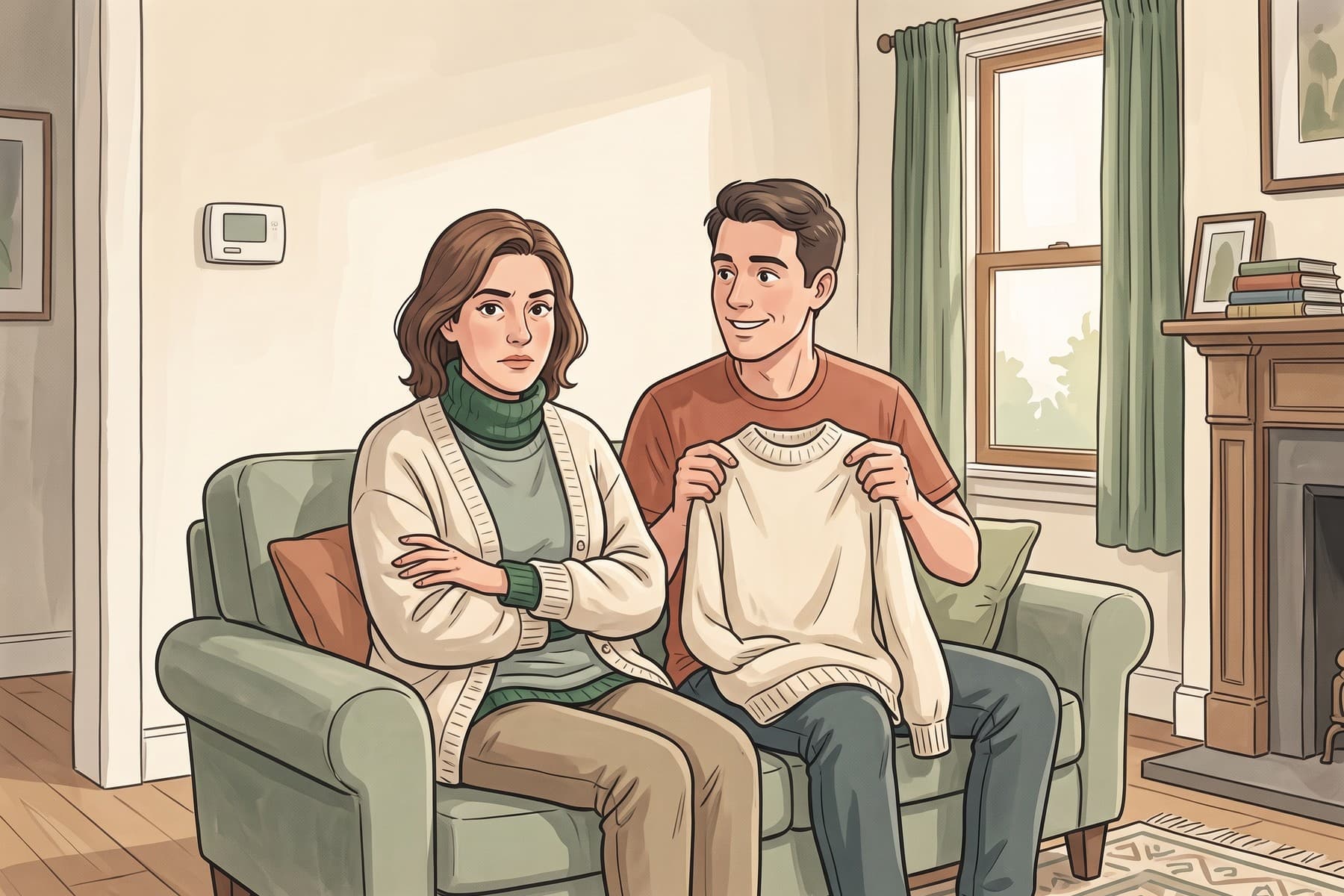
Thank you for this breakthrough
“Just put on a sweater.”
Thank you, sweetheart. Before this conversation, I had no idea clothing existed.
I was simply standing in our living room, waiting for evolution.
Fortunately, you arrived with a solution from the advanced field of Having a Torso. I look forward to your next presentation: Socks, and Where They Go.
To be clear, I understand the sweater. I have located the sweater. I am currently wearing the sweater.
The question is why our shared home now requires a wardrobe change to cross from the kitchen to the sofa.
And before you say, “Well, I’m comfortable”: wonderful. Half the survey is complete.
Your suggestion may be useful. The little shrug that accompanied it has been referred to a separate committee.
I would like to be warm. You would like to stop sweating. Somewhere between those two reasonable requests, we started speaking like opposing attorneys.
Comfortable now. Emotionally, less so.
Fine. The sweater has a case.
Adding clothing changes insulation, so a sweater really can help someone feel warmer. But room temperature is only one part of comfort. Clothing, activity, air movement, humidity, and the temperatures of surrounding surfaces also matter.
Two people can be in the same room and have different comfort needs. “I’m fine” is useful information about one person. It is not a recalibration of the other person.
The sweater can help. It cannot, by itself, decide whose preference sets the thermostat.
UC Berkeley CBE: Factors that influence thermal comfort · Source checked 2026-09-08
A small domestic treaty
Try this together:
- Agree on a starting temperature while neither of you is already annoyed.
- Give each person an adjustment they actually want: a light layer or throw for one, a fan directed toward the other if comfortable.
- Check whether the cold seat is beside a draft or directly in the airflow. A seat change may be more useful than another thermostat debate. Keep registers clear of furniture.
- Change one thing at a time and check how both people feel before changing it again.
Suggested wording: “Would a sweater help, or should we change something in here?”
Same sweater. Considerably better public relations.
Sources, since we’re apparently doing this
UC Berkeley’s Center for the Built Environment explains why clothing and activity belong alongside air temperature, airflow, humidity, and radiant temperature when discussing comfort.
The Department of Energy’s Energy Saver guide covers air sealing, thermostat use, and keeping heating registers clear. These are practical home checks, not evidence that one partner’s preferred temperature is legally binding.
Sources checked September 8, 2026.
Related dispute: You changed the thermostat, not the cooling speed.
Send this to your partner. Please remember we cannot be present for the discussion.
U.S. Department of Energy: Energy Saver guide · Source checked 2026-09-08
Editorial review: 2026-09-08