A loving announcement for the thermostat enthusiast
This is for whoever keeps setting the AC to 60°F because they ‘want it to cool down faster.’
The air conditioner did not see 72° and think, ‘I’ll get to it when I get to it.’
And when you changed it to 60°, it did not put down its cigarette, roll up its sleeves, and whisper, ‘Oh. They’re serious.’
For a conventional single-stage AC, a lower setting means asking it to cool longer—not faster. You’re choosing the destination. You are not upgrading us to priority boarding.
If you want 72°, set it to 72°.
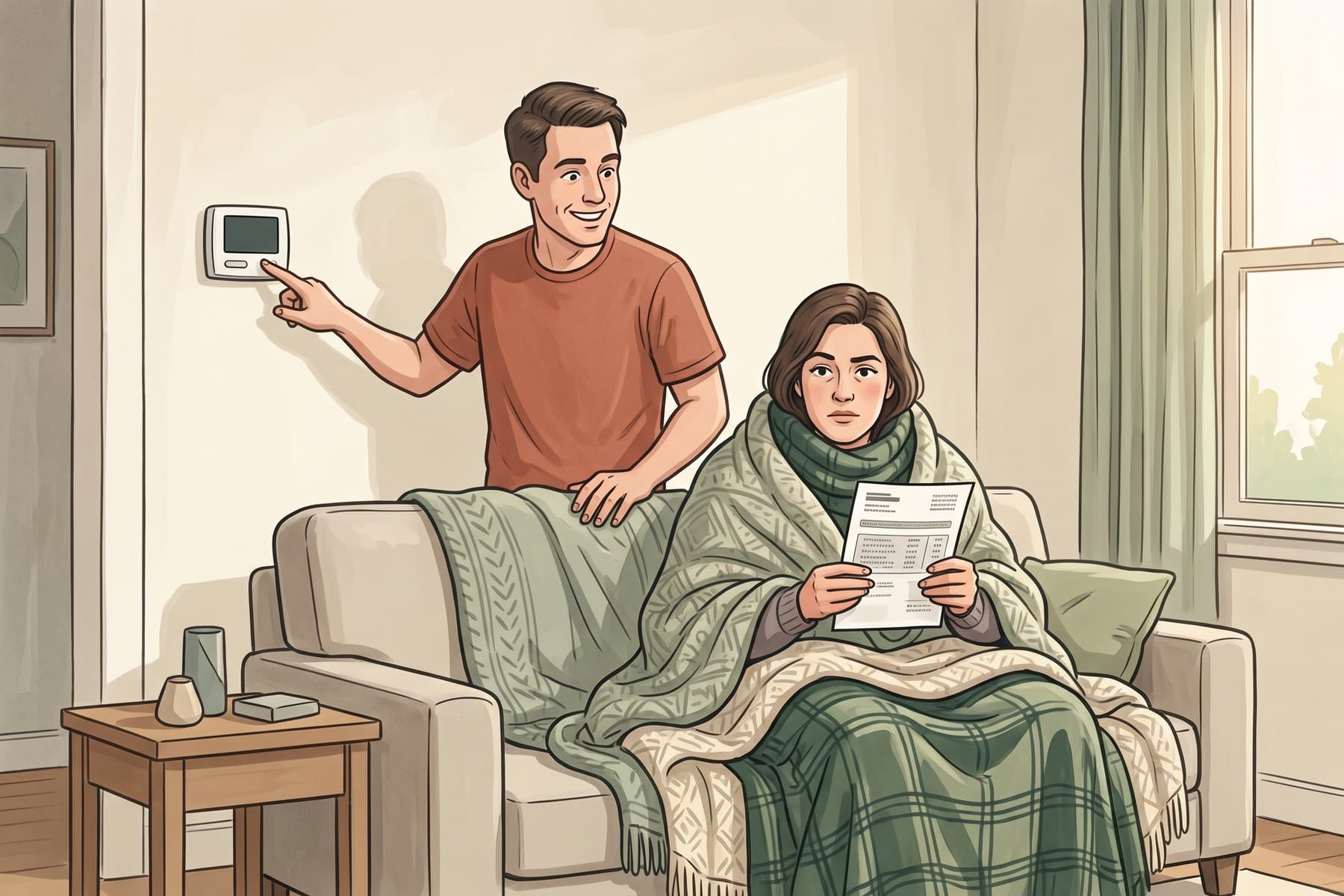
Setting it to 60° tells it to keep cooling past the temperature you actually wanted. That’s how we end up watching television under a blanket while paying for the privilege.
And if the house is stuck at 78° while the AC runs nonstop, selecting an even smaller number does not create additional cooling capacity.
You have entered a wish.
Please step away from the wall
Set the temperature you want. Give the system time. Step away from the wall.
We love your confidence. We just need it to stop operating the HVAC.
If your partner sent you this, they love you very much and would like an independent third party to finish this conversation.
With affection, Temperaly
The actual science, inconveniently
The thermostat setting is a target room temperature. It is not the temperature of the air coming out of the vent. For a conventional single-stage AC that is already cooling, moving the target farther down does not give the compressor an extra gear.
The Missouri Department of Natural Resources advises against setting the thermostat extra cold to speed up cooling: it can lead to unnecessary cooling and expense instead.
Can the house eventually reach that lower temperature? Possibly, if the equipment and conditions allow it. The point is that setting 60°F does not make reaching 72°F faster. Nor does it guarantee the house can reach 60°F.
This explanation focuses on conventional single-stage air conditioning. Two-stage and variable-speed systems can adjust their cooling output, so their response depends on the equipment and controls. Follow your system’s operating instructions. And if the AC keeps running without reaching a reasonable setting, that deserves attention—not another round of aggressive button pressing.
Missouri Department of Natural Resources: Summer Cooling Tips · Source checked 2026-09-08
For the partner who asked for sources
Because apparently your spouse saying it was not sufficient.
- Carrier: How programmable thermostats work explains how a thermostat compares the room temperature with your chosen setting, and why extreme settings do not speed up cooling on fixed-capacity equipment.
- Trane: Understanding HVAC speeds and stages explains the distinction: single-stage equipment operates on or off, while multi-stage and variable-speed equipment can change output. This is why the single-stage qualification matters.
- U.S. Department of Energy: Energy Saver guide, printed pages 17–18, offers things that actually help: appropriate thermostat settings, shading, and maintaining filters. A useful alternative to repeatedly negotiating with the wall.
Additional sources checked September 8, 2026. No spouses were consulted in the preparation of this bibliography.
Editorial review: 2026-09-08