The answer starts with the house and the equipment
Existing ducts may be suitable for a new heat pump, sometimes after targeted repairs. Having a furnace or central AC already connected to them does not establish that they will work with the proposed system. Ask for an assessment before treating either complete duct replacement or reuse without changes as a settled decision.
The useful question is: can these ducts deliver the air each room needs, at the operating conditions required by this particular heat pump? ENERGY STAR's installation guidance calls for evaluating both duct sealing and adequate airflow.
This guide covers central ducted heat pumps. For the equipment basics, start with how heat pumps work.
ENERGY STAR's installation guidance · Source checked 2026-09-07
Follow the complete air path
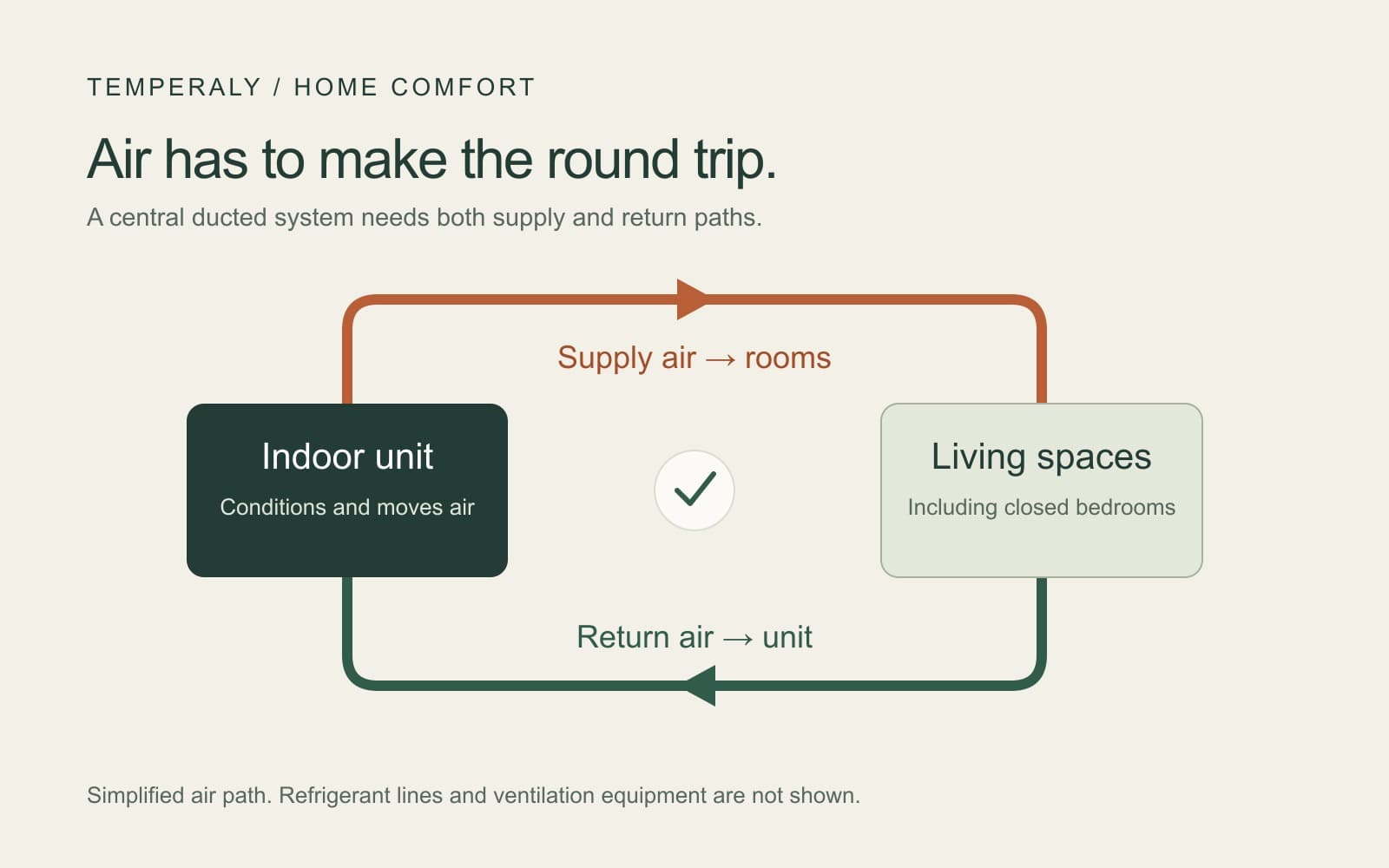
The indoor blower moves room air through a filter and heating or cooling coil, then through supply ducts to the rooms. Air also needs a route back to the return side of the equipment. In a typical split heat pump, the outdoor unit connects to the indoor equipment through refrigerant lines; those lines are not an outdoor-air supply duct.
That is why an assessment should include supply branches, return ducts, grilles, filters, and the indoor equipment together. A problem anywhere along the air path can limit what reaches a room.
A furnace often delivers hotter air than a heat pump. Delivering the same heat with a smaller air-temperature rise can require more airflow, so furnace duct sizing does not automatically establish suitability. See PNNL's traditional split heat-pump guide.
traditional split heat-pump guide · Source checked 2026-09-07
Ask for a design based on your current home
Heating and cooling needs depend on climate, windows, insulation, air leakage, and room layout. A room-by-room load calculation, commonly called Manual J, provides the starting point. Equipment selection then uses the load and the proposed unit's performance data; duct design is a related but separate task.
Mention planned insulation work, an addition, or rooms that have changed use. An old equipment label and floor area alone do not establish the right replacement. In a cold climate, ask how winter heating capacity, summer cooling, and backup heat were considered together. PNNL's cold-climate sizing guide specifically calls for evaluating existing air distribution before reusing it.
cold-climate sizing guide · Source checked 2026-09-07
Get airflow and pressure results, not just a visual inspection
Ask the contractor to record the intended airflow, the measured airflow, and the operating mode or fan setting used. Airflow is commonly reported in cubic feet per minute, or CFM. A universal CFM-per-ton rule is not a substitute for the proposed manufacturer's requirements.
Static pressure is another useful measurement. It helps evaluate the resistance the blower works against. Ask how the measured total external static pressure compares with the equipment's allowed range, and which components are included in that measurement. A pressure reading alone does not prove that every room gets enough air.
Have filters considered in this assessment. Filter size, design, and condition affect pressure drop; a higher MERV number alone does not tell you how restrictive a filter is. If a filtration upgrade is proposed, ask whether the return or filter cabinet needs changing. PNNL explains these relationships in its filter and airflow guidance.
filter and airflow guidance · Source checked 2026-09-07
Check the return path with bedroom doors closed
If a bedroom receives supply air but has no adequate way for that air to return, closing the door can change the room's pressure and circulation. A hallway return is only part of the system: air must be able to reach it from the bedroom.
Ask for room airflow and pressure checks with doors in their normal positions. Possible corrections include a dedicated return, a transfer grille, or a jump duct, depending on the layout. PNNL describes these options in its return-path guidance.
Do not assume that a small gap under the door is enough. Its capacity depends on the opening and room airflow; new carpet can also reduce the opening. PNNL's door-undercut guide recommends checking performance rather than relying on the gap alone.
return-path guidance · Source checked 2026-09-07
Separate leakage, insulation, and sizing problems
These are different findings and may require different work. A leakage test can reveal air escaping from or entering ducts. Inspection can identify disconnected sections or kinked flexible duct. Insulation and its outer covering also matter where ducts pass through an unconditioned attic or crawlspace.
Ask where the problem is, how it was established, and what the repair changes. ENERGY STAR's duct-sealing guide identifies difficult-to-condition rooms and damaged or poorly connected ducts as reasons to investigate. It recommends appropriate duct sealants rather than ordinary cloth-backed duct tape.
Simply adding attic insulation over ducts is not a universal fix. Moisture conditions and the duct assembly must be considered; PNNL's buried-duct guidance treats dry and humid climates differently. Have a qualified professional determine the assembly and repair scope.
ENERGY STAR's duct-sealing guide · Source checked 2026-09-07
Compare three possible scopes of work
Use this table to organize a conversation, not to diagnose the ducts yourself. The appropriate scope depends on the assessment and proposed equipment.
| Option | Evidence | Quote scope |
|---|---|---|
| Reuse | Required airflow can be delivered within the equipment limits, with acceptable distribution and leakage | Testing, setup, and any sealing included |
| Targeted repairs | Specific branches, returns, connections, or filter arrangements are limiting performance | The affected locations and planned corrections |
| Redesign | Existing routes or dimensions cannot reasonably meet the design, or access makes repairs impractical | Ducted, ductless, or combined alternatives and their room coverage |
A proposal should connect the finding to the work. For example, “modify the bedroom return path and verify the result with the door closed” is more informative than “improve airflow.” This is an illustrative scope description, not a diagnosis of your home. PNNL's pre-retrofit assessment guide covers evaluating existing systems and considering alternatives.
pre-retrofit assessment guide · Source checked 2026-09-07
Does variable capacity make the ductwork less important?
No. A system whose indoor airflow decreases at lower output can experience less duct resistance during that operation. It still needs an adequate design for the required higher airflow, and the controls and indoor/outdoor equipment must work together as intended.
Ask the installer to explain the proposed blower behavior at low and high output. Do not assume that an inverter outdoor unit automatically changes the behavior of an existing indoor blower. Green Building Advisor's discussion of variable-capacity systems and ducts is useful further reading on the part-load benefit and the continuing need for good duct design.
discussion of variable-capacity systems and ducts · Source checked 2026-09-07
Put the final checks in the quote
Before agreeing to the work, ask who will perform the final tests and which results you will receive. Commissioning means checking and adjusting the installed system, beyond confirming that it starts.
Ask for a handover record covering:
- The installed indoor and outdoor model numbers and applicable setup instructions.
- Airflow across the indoor coil, including the test mode and manufacturer's target range.
- Room distribution checks and corrections to any identified imbalance.
- Verification of refrigerant charge using the manufacturer's procedure.
- The completed duct repairs and any agreed before-and-after leakage results.
- Filter specification, access, controls, and maintenance instructions.
PNNL's heat-pump replacement checklist includes room-by-room sizing, duct evaluation, coil airflow testing, refrigerant verification, and balancing. Treat this guide as a way to specify the work you want; the installation must also follow applicable local requirements and the equipment instructions.
heat-pump replacement checklist · Source checked 2026-09-07
What you can prepare before the visit
Write down which rooms are uncomfortable, when the problem happens, whether bedroom doors are closed, and whether the system becomes noticeably noisy. Gather previous installation paperwork and the current filter dimensions if they are easy to access. These observations help the contractor investigate; they are not pass/fail tests.
Use the same scope questions for each bid. Ask: “What will you keep, what will you change, and what measurements will show that it works?” Avoid comparing equipment prices while leaving the duct work undefined.
If you are also deciding whether to repair the current system, read repair or replace your HVAC. For the next step, request help planning a heat-pump installation and mention that you want the existing ducts assessed.
Editorial review: 2026-09-07