Ask what the heat pump can deliver on your home’s cold days.
A cold-climate designation is useful, but the quote still needs to match the equipment to your house. Ask the installer for the home’s calculated heating load, the local winter design temperature used, and the proposed system’s heating output at that temperature.
ENERGY STAR’s cold-climate criteria include performance testing at 5°F. That is a certification benchmark, not a promise that every certified unit covers every Minnesota home’s full winter load. The equipment model, house, and backup plan must be considered together.
ENERGY STAR: cold-climate heat-pump performance criteria · Source checked 2026-09-06
Use a capacity comparison instead of a temperature slogan.
Illustrative example only: suppose a home needs 36,000 Btu/h at its chosen winter design temperature and the proposed heat pump delivers 26,000 Btu/h at that temperature. The proposal must explain how the remaining 10,000 Btu/h is supplied. These are invented numbers for explaining the question, not sizing recommendations.
Ask the contractor to complete this sheet using your house and the manufacturer’s performance tables:
| Question | What belongs in the answer |
|---|---|
| What winter temperature was used? | Local design condition and source |
| What heat does the home need then? | Calculated Btu/h |
| What does this matched heat pump deliver then? | Manufacturer capacity data |
| What fills any gap? | Named backup equipment and controls |
| What happens in cooling season? | Summer capacity and room coverage |
Keep the completed sheet with the proposal.
Decide how and when backup heat operates.
A Minnesota dual-fuel design can retain a furnace; an all-electric design may use electric resistance backup. The Minnesota ASHP Collaborative explains that system choice and switchover settings depend on equipment, rates, and the home. Variable-speed cold-climate equipment can carry more of the heating season before secondary heat is needed.
Ask the installer to state both the capacity limit and the operating-cost assumptions behind the proposed switchover setting. Have them explain how to adjust or revisit it if energy prices change. Do not choose a fixed switchover temperature from a generic internet example.
Minnesota ASHP Collaborative: choosing a heat-pump system · Source checked 2026-09-06
Minnesota Power: $1,000 for qualifying cold-climate equipment.
For January 1–December 31, 2026, Minnesota Power lists $1,000 rebates for qualifying cold-climate ducted or ductless air-source heat pumps, and $400 for the standard categories. A participating contractor is required. These are alternative equipment categories, not $1,400 to add together for one system.
Confirm that Minnesota Power serves the home and that the specific equipment and installation qualify. Customers of other utilities should request their own utility’s current terms. A statewide mailing address does not create eligibility for Minnesota Power’s offer.
Minnesota Power: 2026 air-source heat-pump rebates · Source checked 2026-09-06
The Minnesota state rebate is not available yet.
Commerce’s posted June 12, 2026 update says Save Energy Minnesota has not launched, awaits formal DOE approval, and has no estimated launch date. The state heat-pump rebate is tied to HEAR eligibility and has additional audit and home-readiness conditions under development.
Do not put a future state payment in a current contract’s guaranteed discount line. Commerce also advises against delaying necessary repairs merely to wait for the launch.
Minnesota Commerce: residential heat-pump rebate status · Source checked 2026-09-06
Include placement and commissioning in the winter plan.
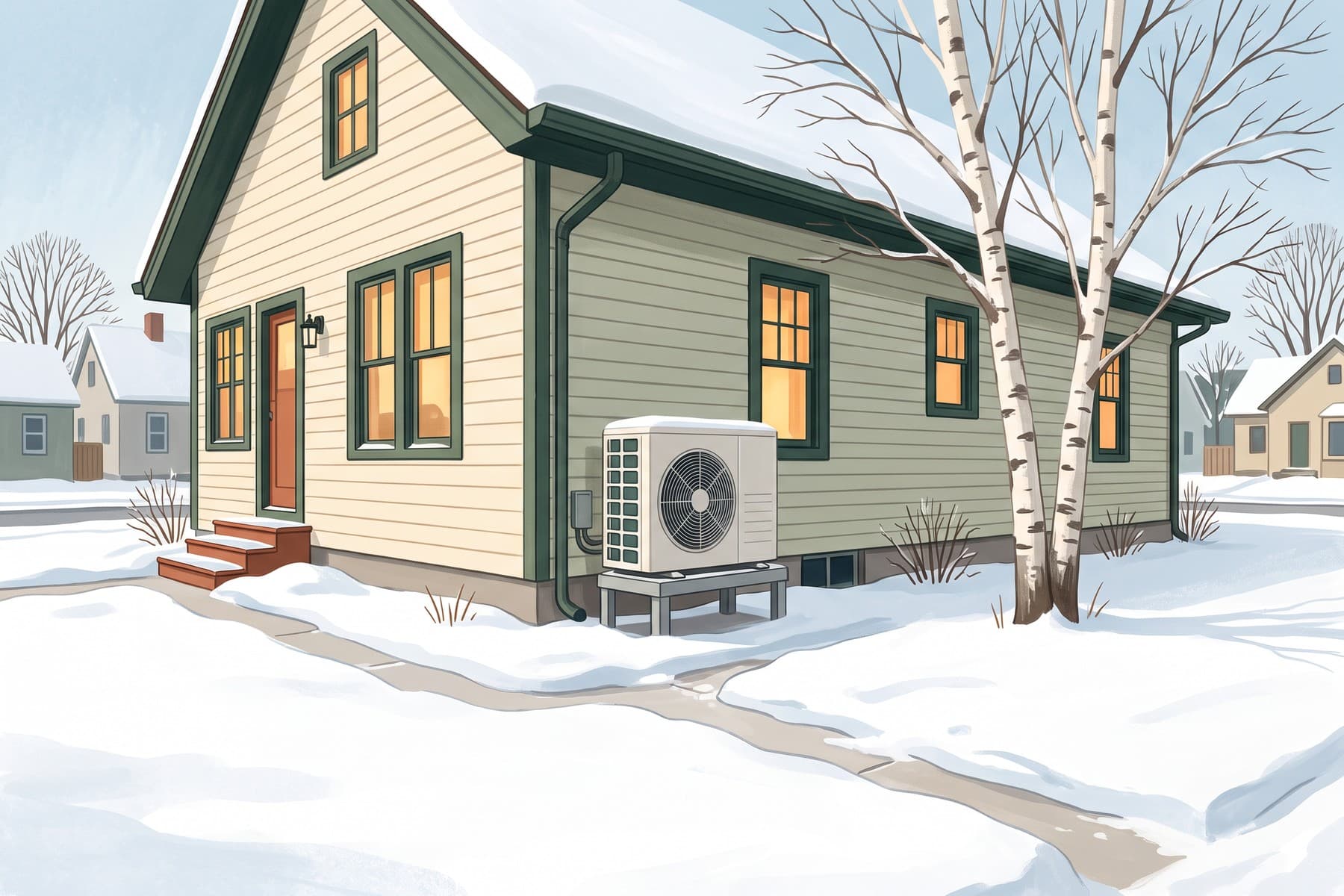
Have the installer show where snow, roof runoff, and service access affect the outdoor-unit location. Ask for the manufacturer’s clearances and the proposed approach to defrost water. These are site-specific design questions; a photograph of another installation is not a specification.
At handover, request a demonstration of normal heating, backup operation, and thermostat settings. Record who will service the system and how the installer wants you to report an unexpected rise in backup use. Compare warranties, maintenance, and the complete installed price alongside the rebate.
Keep old tax-credit promises out of a new quote.
The federal 25C home-improvement credit ended for property placed in service after December 31, 2025. Exclude it from a 2026 installation budget.
IRS: Form 5695 instructions, credit termination · Source checked 2026-09-06
Turn the research into a clear next step.
Sources checked September 6, 2026. Offers can change; confirm the installation-date rules and funding with the program before committing. Temperaly does not approve rebates.
Bring the questions above to your installer, or start a heating and cooling request. A request is not an appointment or a rebate application.
Editorial review: 2026-09-06