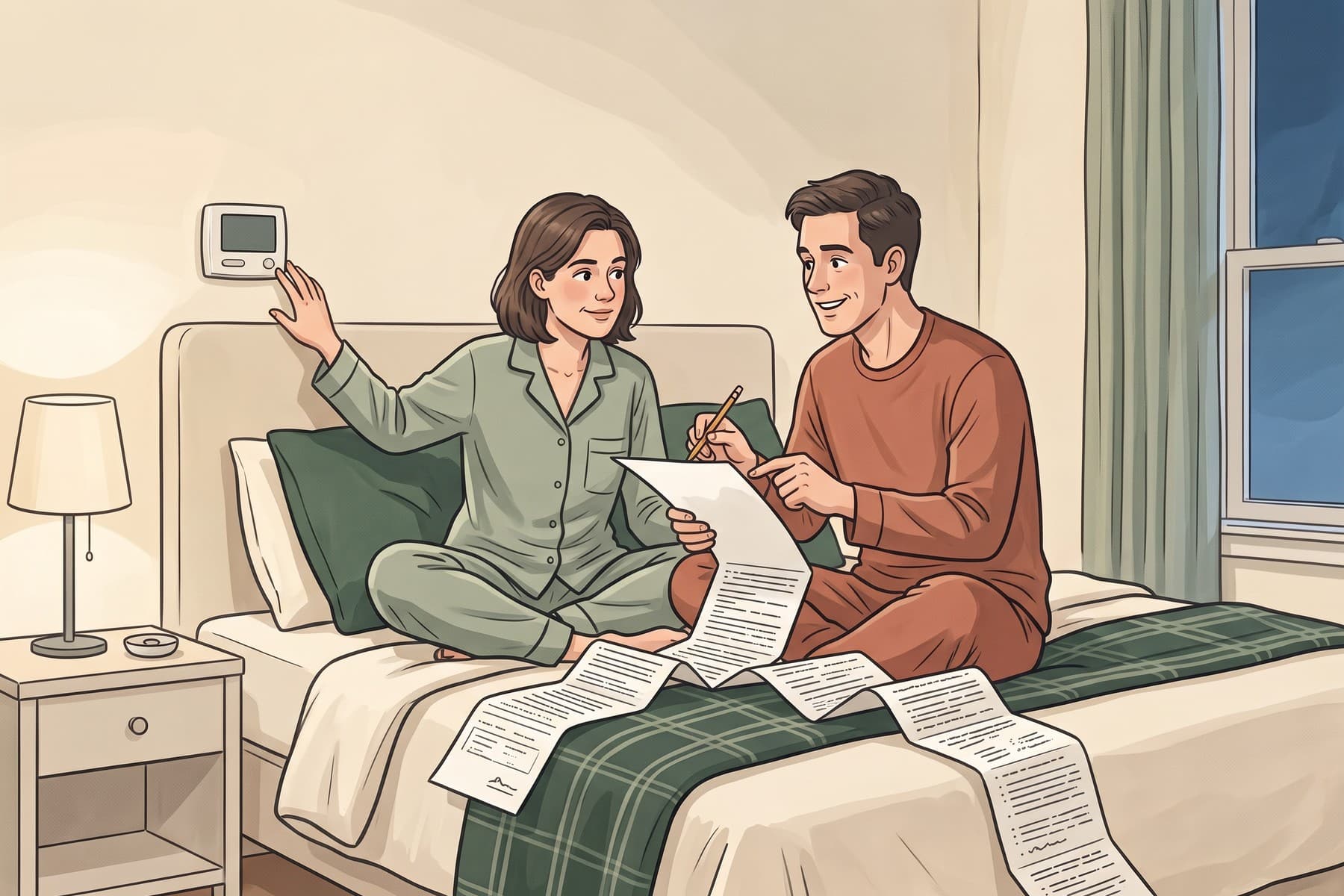
One small omission from the compatibility discussion
We discussed children. Finances. Where to live.
Somehow, “Do you sleep like a tropical orchid or a refrigerated pharmaceutical?” never came up.
Now it is 10:47 p.m. One of us has opened a weather app. The other has produced a study. Neither of us is getting any sleep.
“For better or worse” was apparently too vague. We needed an appendix covering fan speed, window position, duvet thickness, and whether touching the thermostat after lights-out constitutes a hostile act.
You said you wanted a cool room. I thought you meant pleasant. You meant suitable for storing vaccines.
I said I wanted to feel cozy. You thought I meant comfortable. I apparently meant the germination setting on a greenhouse.
We can agree on a thirty-year mortgage. A two-degree adjustment requires renewed consent from both parties and a neutral observer.
Our wedding vows fit on one page. The bedtime temperature agreement has exhibits.
The research has entered the bedroom
Room temperature and the warmth around your body are different parts of the sleeping environment. Sleepwear and bedding provide insulation, so a cool room with comfortably warm covers can make sense.
A small study of 17 healthy young adults compared sleep at 17°C and 22°C with different sleepwear and bedding. It found temperature and sleepwear effects; it did not establish a universal thermostat setting for every couple.
The 64°F in our illustration is a joke about a very specific negotiation, not a recommendation. Nobody gets to wave a paper at their shivering partner and declare the case closed.
Shin et al.: Sleepwear, bedding, and sleep at 17°C and 22°C · Source checked 2026-09-08
An agreement you can try without legal counsel
- Pick a starting room temperature both people can reasonably tolerate.
- Let each person choose their own sleepwear and bedding warmth. Matching pillowcases do not require matching insulation.
- Consider separate duvets if your needs differ, or if the shared one mysteriously migrates during the night.
- Hold the setup steady long enough to judge it. In the morning, compare whether either person felt too hot, too cold, or woke uncomfortable.
- Adjust one part of the setup together. A colder room plus a heavier duvet is not automatically better; the combination needs to work for the person inside it.
This is a practical experiment for your household, not a medically prescribed temperature.
And please conduct negotiations before one of you has brushed their teeth and lost the will to compromise.
Sources for the next round of negotiations
The sleepwear and bedroom-temperature experiment supports considering clothing and room temperature together. Its small, specific participant group limits how broadly its results should be applied.
A separate 16-person quilt study found that comfortable room temperatures were related to bedding insulation. That supports giving each sleeper some control over their covers; it does not identify one perfect setting for all bedrooms.
Sources checked September 8, 2026.
Related dispute: You did not need custody of the entire duvet.
Send this to your partner. Please remember we cannot be present for the discussion.
Zheng et al.: Quilts and comfortable indoor temperatures during sleep · Source checked 2026-09-08
Editorial review: 2026-09-08